electricgecko

Juli

The mezzanine level of Sightglass is bustling at this time of the day, making the fact that the lower floor is designed to hold a maximum of ten patrons at full capacity all the more commendable.

Along the bar, a free as in coffee startup consultation is taking place, the vocal fry soothing over whatever deep domain experience, human ressources and management background is relayed to two young trucker-jackeded entrepreneurs. The phrase fermented time is uttered and followed by a pause for added effect.

Despite the amount of business conducted in the former warehouse, the overall mood remains calm and Californian. It’s friday after all. Down below, the barista adjusts the small red comb in his sizeable afro after pulling what is presumeably the four hundred twenty second espresso shot of the day. He wipes a hand on his Queen shirt, skull motif. It has been a long day. Outside, the clouds lay heavy and low on the sightlines to downtown and Telegraph Hill. A single slim figure disappears into the haze. The dogs keep barking and a week proceeds to wind down.

Sightglass Coffee, SoMa, San Francisco.

Mai

The thing is, everybody wears very good sneakers: With tight fitting sweatpants, peaking below striped djellabas and dashikis, combined with dresses, tracksuits and leggings are the chunky, the limited and the collaborative, gleaming white or radiating volt, pink and, sometimes, a multitude of iridescent. Intermediate-level Vapormaxes (Utility, Flyknit, Plus) seem to be stakes to play dans la rue, one-upped by 720s, Kiko Kostadinov’s Gel-Delvas and the bulbous sculptural offerings Han Kjøbenhavn and Puma have been putting out lately. The general selection slants soccer and running, mediterranean street kid and La Haine. Athletic footwear choices speak of discernment and respect for the urban space: look good when stepping outside, you owe the streets of Marseille.

Marseille is an impressive, varied assembly of architecture. Both the elevated and the mundane are housed in thoughtful (or at least, deceisive) structures that weave into a gritty, dense fabric that presents its scars as proudly as its triumphs.

A young man passes, his architecturally sculpted upper body squaring Rue d’Aubagne. Grey technical fabric spans voluminius chest muscles, disproportionally slim legs stick out from boxer’s shorts in shiny leggings, their panelling suggesting a martial future for everybody. His hair is cropped into a precise fade. Above the left ear, a succession of shaven vertical lines combine with a longer horizontal one: a thick barbell, the straightest possible, most elegant commitment to his sport, to be renewed daily, during morning routine.

April

Marseille: a landscape overrun by infrastructure, flowing, abruptly ending on geologic barriers. Inhabited caves and machines, steep cliffs of built limestone, a sea of lives lived extending into the horizon, up and under bridges, weaving foot traffic through houses and below kitchens and gardens. A drawn city, a pastiche on paper, all colorful dust and complex views. A decidedly non-urban urban space, a grown stone organism, a Moebian landscape, a Cité Obscure.

Everything at Winsome, Los Angeles, radiates comfort. Woods and leathers are light, the space is airy and, at this time of day, mostly empty. Everything about layout, menu and personnel suggests American diner, albeit re-colored, re-tooled and re-cast to fit the Silver Lake set. A backdrop against which meaningful glances may be exchanged, plans made, and, most importantly, intents are declared as loudly and clearly as possible.

Two tables over, masculine drawls discuss cast and casting for an upcoming project. It is repeatedly referred to as a „feel good movie“, a group of words that seem purposefully assembled to enable maximum vocal fry. The granola is served with strawberrys, and it is excellent, as every granola in California tends to be. Ice teas are ordered before, after and with everything.

„Martinis are better in daylight“, another declaration, made over the faint clinks of clear ice cubes in thin-walled glasses, as another day, and another power brunch passes on the patio, in bright sunlight and stark shadow.

Winsome, Silver Lake, Los Angeles.

Dezember

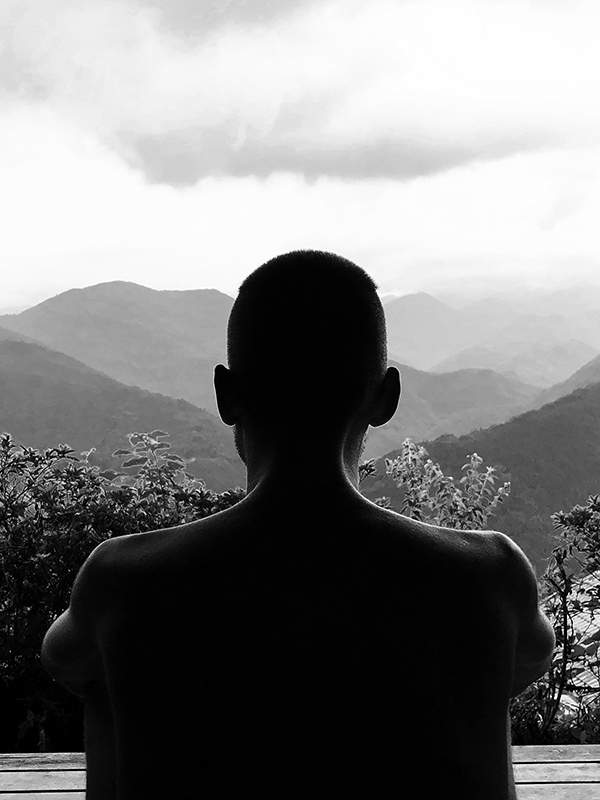
Four days in September, I lived in the refurbished remains of a 1970s apartment building, constructured for a long-gone working class in Kyoto. I laundered my clothes in its cellar, I slept beneath its raw concrete ceilings. I witnessed the strongest taifun through its latticed windows, the rain slashing around Hōkanji, which stood unimpressed, as it has forever. Within the howl, all fell silent. I remember overlooking Higashiyama, its houses made from aging wood (noticing how its particular gradient is determined by age and exposure), the trees and rocks – as if all this was my home. As if it had years of my life to emblazon itself into my brain. A concrete box in a taifun, my love and me inside, and our clothes hanging to dry on an extendable fishing rod across the room. A day to itself, in this year of change and momentum (at RC Hotel, Kyoto).

One of the most significant things about the urban fabric of Japanese metroplexes is the number and cultural integration of 7-11, Family Mart and other convenience stores: Multi-purpose hubs, more or less 24 hours per day, for all kinds of social strada. They provide grocery shopping assistance to the elderly, free Wi-Fi to tourists, wastebins and agreeable cheap food to everyone. The Famima entrance jingle is one of my strongest and most present memories from my times spent in Tokyo and other japanese cities. These stores cry for ethnographic inquiry beyond William Gibson’s inquisive modelling of the Lucky Dragon franchise in All Tomorrow’s Parties.

Die Kieswege und der Geruch nach Zeder, moosgrüne Steinlaternen, gewundenes Holz, glimmendes Licht in ausgehöhlten Bambusrohren, überhaupt: Bambus. Rinzai-Rot-Orange. Wetteiferndende Zikarden an den Ufern jedes Rinnsals. Das dichte, schweigende Moos entlang sorgsam angelegter, gleichsam planvoll gewachsener Blickachsen.

Walking the streets of Osaka by myself after nightfall, immersed in neon light and concrete, the 1980s endlessly reflected long since their time has ended. I have no purpose here, other than keeping momentum, researching myself in alley corners. 2015 seems a long time ago, I think, as I head back to Dōtonbori to meet a woman under battered Ezaki Glico, research unfinished and thoughts unthought.

September

There was one of the perfect silences in the 100-Meter Gallery of Odawara Art Foundation. You know, the considered kind that includes a faint hum of air condition running at its lowest setting. There was no movement of air. This is what can be learned from the Japanese: Silence. The silence of deferring to the dao of all things, while doing what has to be done by playing one’s part, elegantly. The silence of recognizing each thing’s and each being’s part. The silence of doing nothing when all is done.

Watching the slim, immaculate fingers of the JR East clerk fly over a landscape of unlabeled, but color-coded hardware keys, each press producing the kind of satisfying mechanical click keyboard afficionados have been paying substantial sums for, I wonder whether his fingertips have already flipped open to reveal a set of spidery steel rods, inputting data with superhuman speed and precision. The clerk is wearing a short-sleeved grey button down, embroidered with the vaguely brutalist JR logo. His physiogonomy, attention and complete being could not be more focused. Around him, an assortment of laminated scraps of paper, highlighted katakana phrases, flyers and maps is taped into a Monet-esque array of tranquil color. The dynamic silence of faint office sounds surrounds us.

Everything is permanently going down. The only thing left for us to care about is how we and every thing goes down. This is why leaving small stone mounds along the hiking trail matters. This is why making good rice bowls matters. This is why optimizing your CSS grid matters. Matters of grace are actually this: matter. It’s in defiance of the universe that we apply attention and care to small things. It’s a gesture, and gestures are all we have. Put care and love into every move, in defiance of your insignificance. Create matter by claiming it emphatically and carefully. (On mossy rocks halfway between Hongu-Taisha and Yunomine-Onsen)

You look so grim, Craig said.

Wakayama

August

Everybody and everything at Schumann’s Tagesbar appears to make an effort to contribute to a specific script, emulating mid-century day-drinking and one of the later iterations of the Leisure Suit Larry series of computer games at the same time.

Regulars line the bar on stools upholstered in oxblood leather, having crémants and trying to coax nightlife credibility out of the well-informed and strategically tattooed bar staff. The latter communicates like a disciplined sports team – orders are shouted across the room in shorthand language, matching requested drinks with staff members closest to the required appliance or bottle.

There is a short moment of silence, slightly moving air and long gazes. A party of three enters, surveying the establishment, a shaggy dog in tow. A short tour of the sparsely populated interior seems to end inconclusively and unsatisfactory: „There is no place for us here“, one declares as the group exits stage left.

The same moment, two women in sand-colored robes enter, their faces veiled. Nonetheless, they are recognized and treated to the usual: two slices of apple pie and two iced chocolates.

Underneath it all, faint bossa and tropicana muzak is heard and immediately forgotten, evaporating over ruby-colored drinks and a dazzle of miniature canapés, all traces of crust surgically removed from soft toast slices. Time slows in the most pleasant way.

November

When I was a child, I would sneak from my room on saturday mornings, and switch on the TV. I would watch CNN World News, not catching much of its content, but savouring a diffuse internationalism that was lacking from my environment. It was of endless fascination to me. My favourite segment was the global weather forecast. It always included Kuala Lumpur, showing a hazy, grainy cityscape as filmed by some rooftop-mounted camera. The city’s name and its dreamy optics resonated with me every time, and I would give in to daydreaming about this place and others, that somehow were supposed to lie on this same earth I was beginning my life on. (03-31-17)

The specific south east asian rain poured down yesterday, observed from our condo on the 27th floor. The rain announced itself by a thick haze settling down in a matter of seconds, descending from the sky, filling the voids between arcologies. The light did not fade, but is dispersed, refractured in a different way. Then, the rain started. A grey veil, blending with KLCC’s monolithic architecture. With it come the lightning strikes and thunderclaps, feeling close, almost as if originating from inside our room.
(01-04-17)

(Aus meinen Reisenotizen in Kuala Lumpur)

September

Neapel ist eine Art zusammengeschmolzener Klumpen der vergangenen zweitausend Jahre am Mittelmeer. Wohnhäuser, Fahrzeuge, Marktstände, Statuen, Pflanzen – alles ist Teil eines gleichen, texturierten Stadtmaterials. Vollkommen unbekannt ist die lineare Folge von Straßen zu Plätzen zu Bauten, wie man sie aus dem irgendwann in die Pläne einer aristokratischen Klasse gezwungenen Inneren großer europäischer Städte kennt.

Vielmehr entspricht Neapel dem unüberblickbaren Gewirke ostasiatischer Großstädte: geeignet, Invasoren zu desorientieren, ohne Unterscheidung zwischen Infrastruktur, Architektur und privat organisiertem Räum. Bauten sind Material, Ruinen sind Material, Märkte und andere temporäre Raumorganisationen sind Material. Via San Antonio Abate ist näher an der Jalan Tun Razak als am Place d‘Aligre. Neapel altert uniform, in einer gleichmäßigen Patina aus Sandsteinschmirgel, Schwärzung und Bruch; die Übergänge sind fließend. Mit jedem Tag schreibt sich das Gefüge der Stadt tiefer in sich selbst ein, Wildnis, Steppe.

Die Straßen Neapels sind der Ort der Performance (und der Ort für alles Andere), wie das häufig der Fall ist in Städten, in denen um vieles gekämpft werden muss. Was Stil angeht, fallen zwei Dinge auf.

Erstens: Die überzeichnete Silhouette der Ramones-Sneaker von Rick Owens hat in Neapel die subtilere des Converse-Originals abgelöst. In einer Art Möbiusschleife kultureller Referenzierung ist die Comic-Version des simplesten Sneakers der Welt hier wieder angekommen und zum Default geworden: Der 25-Euro-Fake eines Luxusprodukts, das vermutlich weder seinen ostasiatischen Herstellern noch seinen Käufern bekannt ist. Jede Altersgruppe trägt die massiven weißen Sohlen und den Zip auf der Innenseite – mutmaßlich ohne den Versuch, Status und Geld zu demonstrieren, sondern aus Lust an der Lautstärke, an Präsenz und Sichtbarkeit.

Zweitens: Pyrex‘s not dead. Das (Fake-) Echo1 von Virgil Abloh‘s Streetwear-Versuch hallt durch die neapolitanischen Straßen, das Momentum der Beflockungsmaschinen war zu groß, sie laufen weiter. Gemüsehändler tragen die Shirts zur Arbeit, ihre Freundinnen die Trainingshosen zu Pumps. PYREX, eine Reihe ziemlich guter Buchstaben, der Name eines Kochtopfherstellers, encodiert von Pushern und Tickern, gesampled, geflockt, gefaked, cargo-kultiviert am südlichen Ende des geistigen Europas. Semiotik kann schwindelerregend sein.

  1. Turns out: Das Label führt ein untotes Leben auf dem italienischen Markt, in größerem Umfang und vermutlich höherer Qualität als das kurzlebige Original. ↩︎

Neuere Texte über Orte

Ältere Texte über Orte